
Care Guide / Hardwood / LVP
Choosing a Rug Pad for LVP: Backing, Grip and Discoloration
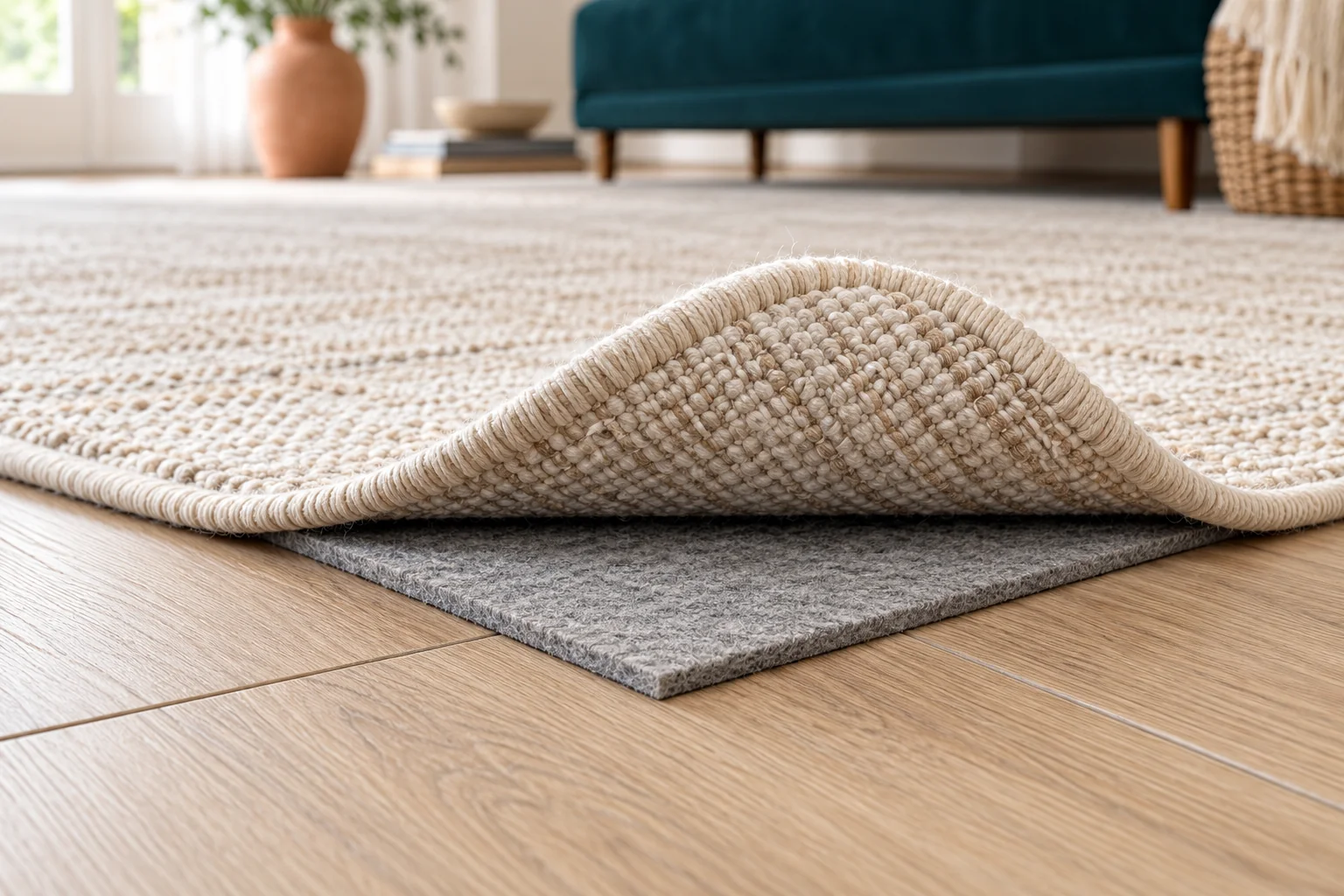
The right rug pad for luxury vinyl plank starts with the floor manufacturer’s instructions, followed by confirmation about the exact pad and rug backing. A package that says suitable for hard floors does not answer every LVP compatibility question. Check both the material touching the floor and whether the complete rug setup will stay in place.
In This Guide
All ArticlesKeep This in Mind
Choose the rug and pad around your specific vinyl floor’s care instructions. Surface compatibility, grip and cushioning are separate questions.
Identify the floor before buying the pad
Find the flooring brand and collection on an installation invoice, spare plank box or purchase record. Wood-look flooring could be vinyl, laminate or engineered wood, so appearance alone is not enough. Ask the flooring manufacturer which rug backings and pads it permits for that product.
Next, identify the pad’s floor-facing material and the rug’s own backing. Ask the pad maker to confirm compatibility with your named flooring, including any restrictions. Save both responses. Terms such as natural rubber, PVC-free or suitable for hardwood do not independently establish approval for your particular vinyl floor.
Sources: Shaw Floors: Vinyl Care and Warranties · RugPadUSA: Vinyl and Vinyl Plank Rug Pads
Take backing restrictions literally
Shaw’s vinyl-care guidance recommends entrance mats without latex or rubber backing to reduce possible discoloration. If those are your floor’s instructions, do not override them because a pad seller uses a broad vinyl-safe claim.
There is a material reason to ask. Armstrong’s commercial maintenance guidance explains that certain additives in rubber can react with ingredients in flexible vinyl and produce yellowish staining. That explanation concerns a specific mechanism and product context. It does not prove that a mark on your floor has that cause, or that one backing is appropriate for every LVP product.
If the floor and pad instructions conflict, leave the combination unused until the manufacturers resolve the conflict for the exact products.
Sources: Shaw Floors: Vinyl Care and Warranties · Armstrong Flooring: Commercial Maintenance FAQs
Separate compatibility, grip and comfort
A pad can cushion a rug without providing the grip needed for its location. RugPadUSA, for example, describes its dense felt option for larger rugs that do not require a non-slip pad. That distinction matters when comparing a large living-room rug with a small runner by a patio door.
Surface compatibility
Does the flooring maker permit the backing or pad material? Check every layer that may contact the floor, including the rug itself.
Grip and placement
Does the product provide the hold needed for this rug size and location? Consider walking routes, door clearance and edges that could bunch or lift.
Cushioning and fit
How much padding is appropriate under this rug? Follow the rug and pad makers’ sizing instructions, and do not assume greater thickness is always better.
Make lifting the rug part of routine care
For an Orange County household that uses a patio or garden entrance, the practical issue is what gets tracked across that threshold. Choose a floor-compatible entry mat and keep it clean. When maintaining the room, inspect beneath rugs and pads as well as around their edges.
Remove loose grit using the method permitted by the floor manufacturer before any damp cleaning. Shaw recommends removing dry soil first and using a recommended neutral-pH cleaner for routine vinyl care. Avoid adding a stronger product simply because the area was covered.
Inspect the pad for dirt, deterioration or a sticky floor-facing surface. If something has changed, photograph it and pause use while you confirm the cause and the appropriate replacement or care method. A rug should not become a permanent cover over an unresolved floor concern.
Sources: Shaw Floors: Vinyl Care and Warranties · OCD HOME: Hardwood and LVP Floor Care
Handle a spill as a rug, pad and floor problem
OCD HOME’s area-rug guidance is to blot a spill with a bleach-free white cotton towel without adding moisture or cleaning products, then check the label and contact us. A liquid that reaches below the rug needs attention to the pad and underlying floor too.
If the rug can be moved safely, lift the affected area to check underneath. Follow the floor maker’s spill instructions and allow the floor, pad and rug to dry fully before covering the area again. If the rug is too heavy or the spill is extensive, request help instead of dragging a saturated rug through the room.
Tell us what the floor is when arranging rug care. Our rug assessment considers the fiber, dyes, backing and underlying surface. We do not clean rugs over hardwood, and a vinyl installation should also be identified before choosing where and how the rug is cleaned.
Sources: OCD HOME: First Steps After a Rug Spill · OCD HOME: Area-Rug Cleaning
A mark under the rug is not always removable soil
Residue, a stain, fading and physical wear can require different responses. The outline of a rug or pad alone cannot establish the cause. Avoid trying to erase the outline with solvents, abrasives or repeated wet scrubbing.
Photograph the dry floor, the underside of the rug and both sides of the pad. Note how long they were in place, any spills and the products used. OCD HOME can assess suitable cleaning for LVP soil and residue; cleaning does not repair a damaged finish, remove every discoloration or replace affected planks. If a material reaction is suspected, involve the flooring manufacturer before deciding on further work.
Sources: OCD HOME: Hardwood and LVP Floor Care · OCD HOME: Dull or Hazy Floors
Professional Help
Hardwood / LVP Care
Explore the process, preparation advice and service options for your Orange County home or business.
Explore the ServiceSources & further reading
OCD HOME’s care guidance combines our published service process with the material-care resources below. Always follow your manufacturer’s current instructions.